quarta-feira, 19 de outubro de 2011

Pink river dolphin

     Also known as the boto, the Amazon river dolphin is one of the world's three dolphins that are constrained to freshwater habitat. The species is widely distributed throughout much of the Amazon and Orinoco river basins. Like its relatives elsewhere, the boto's habitat is threatened by river development projects: Hydroelectric and irrigation schemes separate rivers in bodies of waters, which may reduce the species range and its ability to breed.

     The boto has a pale pink colour, and is different from other dolphins because it has a flexible neck, which allows it to move its head left and right. It has a long snout, a rounded head and small dorsal fin, with overall length varying from 2 to 2.5 m. The boto feeds on fish and other aquatic organisms such as turtles and crabs.

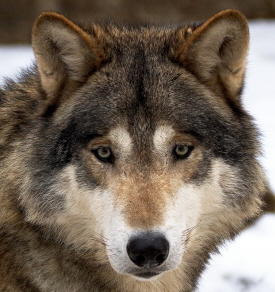
Grey Wolf

Key Facts

       ·          Common Names

Grey wolf, timber wolf, common wolf, tundra wolf, mexican wolf, plains wolf

       ·         Scientific Name

Canis lupus

       ·         Status

Least concern;


·         Geographic Location
Asia, Canada, Europe, USA
             
          Physical Description:
         
The grey wolf varies in colour and size according to where they live. The grey wolf has strong jaws with sharp canine and teeth for tearing and chewing meat.
Size:
Length: 120-200cm
Height: 70-80cm
Weight: 20-60kg

Hunting:
Wolves usually hunt in family  of between 3 and 30 wolves.
Hunting together helps wolves kill large animals such as moose or elk. They are good swimmers and when necessary pursue their prey into water.

A big appetite:
The timber wolf can eat a lot of meat at one meal and then go without food for a considerable time. . It also eats fish, crabs and dead animals.
      
Family life:
          Mating takes place in late winter or early spring. A litter of 4-6 pups are born 2 months later. The family stays together for some time while the parents teach the pups hunting skills. In about a year, the cubs reach adulthood, but may stay for longer.
          The wolf's biggest enemy is man. For many centuries, wolves have been trapped, shot and poisoned because people fear that wolves present a danger to cattle and sheep. They were killed for their fur.
Wolves seldom attack humans. As long as there is plenty of natural prey, wolves prefer not to attack domestic livestock.
What is WWF doing?
WWF is helping wolves spread into suitable remote areas from areas where they already exist.
This includes research projects to evaluate wolf populations and measures to address the concerns of farmers and other local inhabitants who feel threatened by the presence of wolves.       


Accomplishments


1960s:

     In its first decade, WWF raiser over US$5.6 million – a huge amount of money in the 1960s.
     The money was distributed as grants to support 356 conservation related projects from wildlife surveys to anti-poaching efforts to education. Many of the animals and habitats supported became iconic conservation symbols, and continue to be a focus of WWF’s work.
For the first time, conservation was brought to the public arena.

1970s:


     Although WWF continued focused on species and habitats preservation throughout the 1970s, its approach changed.
     They began encouraging more comprehensive conservation projects to help entire biomes as well as species across their range, instead of supporting individual projects.


1980s:


     By its 20th anniversary, WWF had already supported protected areas on five continents and contributed to save a number of species.
     This was very impressive but the organization realized it wasn’t enough. Now that they were starting to run their own projects, WWF began promoting their founders’ ideas: that conservation was in the interest of people and needed to be integrated into development, instead than viewed as in conflict with it.

1990s:

     In the 1990s people began to accept the global link between the environment, human activities and human welfare, as well as the importance of biodiversity and the emerging threat of climate change.
     These issues were incorporated in WWF’s 1990 Mission Statement and have framed the organization’s policy work since then. WWF developed a global conservation strategy that focused efforts on the world’s most critical ecoregions and in six key areas (species, forest, marine and freshwater conservation, climate change and toxic chemicals. WWF also began engage with business and other partners to promote sustainable resource management.

2000s:


     In the turn of the century, WWF increased its ambition, aiming for transformational changes that lead to lasting conservation, sustainable development and sustainable lifestyles.
     With the two goals of conserving biodiversity and reducing humanity’s ecological footprint, the organization is trying to create innovative partnerships that integrate conservation, policy and advocacy, and strategic private sector engagement. These efforts are particularly focused on globally important areas and species.

History

     One of the most important people in the beginning of the WWF’s history was the British biologist, Sir Julian Huxley. He was the first director general of UNESCO and had also help found a scientific research-based conservation institution, now known as IUCN-The World Conservation Union.
     In 1960, Julian Huxley went to East Africa to advise UNESCO on wildlife conservation in the area. He was very surprised by what he saw, so when he returned to London he wrote 3 articles for The Observer newspaper warning the British public that habitat was being destroyed and animals hunted at such a rate that much of the region’s wildlife could disappear within the following 20 years.
     They alerted readers to the fact that nature conservation was a serious issue. Huxley received many letters from concerned members of the public; one of these was from a businessman called Victor Stolan, who pointed out the urgent need for an international organization to raise funds for conservation.
     However Stolan said he wasn’t in a position to launch such an organization himself. Therefore Huxley contacted Max Nicholson (Director General of Britain’s Nature Conservancy) who accepted the challenge.  
     By spring 1961, Nicholson had already gathered together a group of scientists, advertising and public relations experts. One of these experts was Peter Scott (a vice-president of IUCN) who later became the new organization’s first president. The group decided to base its operations in Switzerland, in the small town of Morges (on the northern shores of Lake Geneva).
     On the 29th April 1961 they produced the Morges Manifesto. The document signaled the very beginning of WWF as we know it today.  

segunda-feira, 17 de outubro de 2011

World Wildlife Fund

    World Wildlife Fund (WWF) was created on 29 April 1961,when a small group of passionate and commited individuals signed a declaration that come to be know as the Morges Manifesto.


     WWF's mission is to stop the degradation of our planet's natural environment, and build a future in which humans live in harmony with nature.


How do they do this?
     They make innovative parterships that combine conservation, level policy and advocacy.On the other hand they try to make business and industry more sustainable. They are focusing on concerving critical places and critical species that are particularlt important for their ecosystem or for people.
     They are also working to reduce humanty's ecological footprint, in other words the amount of land and natural resources needed to suply our food, water, fiber and timber, and to absorb our carbon dioxide emissions.
     They don't want to keep people away from nature or to prevent countries, communities and industries from developing.They want to find practical solutions to make our planet "heathy". They want a planet where people can live in harmony with the environment , in a planet with sustainable resources so that many future generations can enjoy our great planet.
     To achive this, they are working with their partners to:
  • Save biodiversity, and 
  • Reduce humanity's impact on natural habitats.